
SEMViD Vaccine
Immediatly after the genomic sequence of SEMViD became available, virtually all large pharmaceutic companies initiated development of vaccines against SEMViD. While all started with differented approaches, increased international cooperation and data sharing allowed for fast international availibility of a vaccine. As a result, the SEMViD vaccine had the shortest time-difference between discovery of the virus and worldwide availability of the vaccine.
Development
As first analysis of the SEMViD genome became available on 14th July 2050, after sequencing at Universitiy Hostpital of Zurich. Thanks to international data sharing, this sequencing data became available all across the world. As soon as they received this data, pharma companies started development of their vaccines, each working independently, using their own vaccine platforms to speed up the process of vaccine development. The approaches used range from classical mRNA vaccines, over trans amplifieingRNA to protein vaccines. Thanks to recent innovations, such as TargetFind, an AI designed to identify the proteins most suitable as targets for the vaccines, BPP3 and NSB5 were identified as the ideal targets. While some companies decided to focus their vaccine on one of those proteins, SEMVac by Pharamvac combinded both into one vaccine. AI aided structure optimization allowed to generate sequences for slightly altered target proteins with higher immunogenic potential. while also providing high specifity. Constant sequencing of the virus was employed to screen for potential mutations in the target protein. As simulations showed one mRNA vaccine to be effective, Pharmavac attempted to change additional vaccine components to allow for target group specifity. At August 2050, a first candidate entered testing phase. Due to progress in simulations, biochips and model organism, the first two stages of clinical testing could be sped up. Therefore, the third stage of testing lasted through September and October. In the middle of October, as the study looked promising, production facilities all around the world prepared for mass production of the vaccine, enabled by a licensing agreement with the producer. In November, the mRNA vaccine SEMVac was approved by most authorities, leading to a world-wide availibility as soon as December of 2050.
Distribution & Availability
The first complete genomic sequence of the virus was obtained at the University Hospital Zurich, Switzerland, on 14 July 2050. Following the publication of the sequence, vaccine development programmes were initiated in several countries. International regulations for scientific cooperation during health emergencies, established in the decades following the COVID-19 pandemic, enabled laboratories to share genomic, clinical and epidemiological data openly. As a result, several vaccine candidates were developed simultaneously using different technological approaches, reducing dependence on a single research group or manufacturing programme.
A major factor in the subsequent distribution of the vaccine was the decentralisation of vaccine production. Rather than relying primarily on a small number of large manufacturing sites, production facilities had been established in several regions before the outbreak. Through expanded programmes coordinated by Gavi, vaccine manufacturing capacity was developed in a number of low- and middle-income countries. These programmes provided access not only to vaccine doses, but also to manufacturing technologies, technical expertise and established vaccine platforms. Facilities in different countries were therefore able to manufacture the vaccine according to common safety and quality requirements. This reduced the dependence on international supply chains and made it possible to produce and distribute vaccines closer to the populations in need.
Between December 2050 and October 2051, approximately 15 billion vaccine doses were manufactured worldwide. Around 20% of total production took place in Europe, 15% in North America, 30% in East and Southeast Asia, 20% in South Asia, and the remaining 15% in Latin America, Africa, the Middle East and Oceania. The decentralized production system allowed several regions to manufacture vaccines simultaneously, substantially reducing the delays that would have resulted from transporting all doses from a limited number of production sites.
Global vaccination began in December 2050. During the initial phase, priority was given to healthcare workers, people at increased risk of severe encephalitis and populations in areas experiencing active outbreaks. As production increased, vaccination was expanded to the wider population.
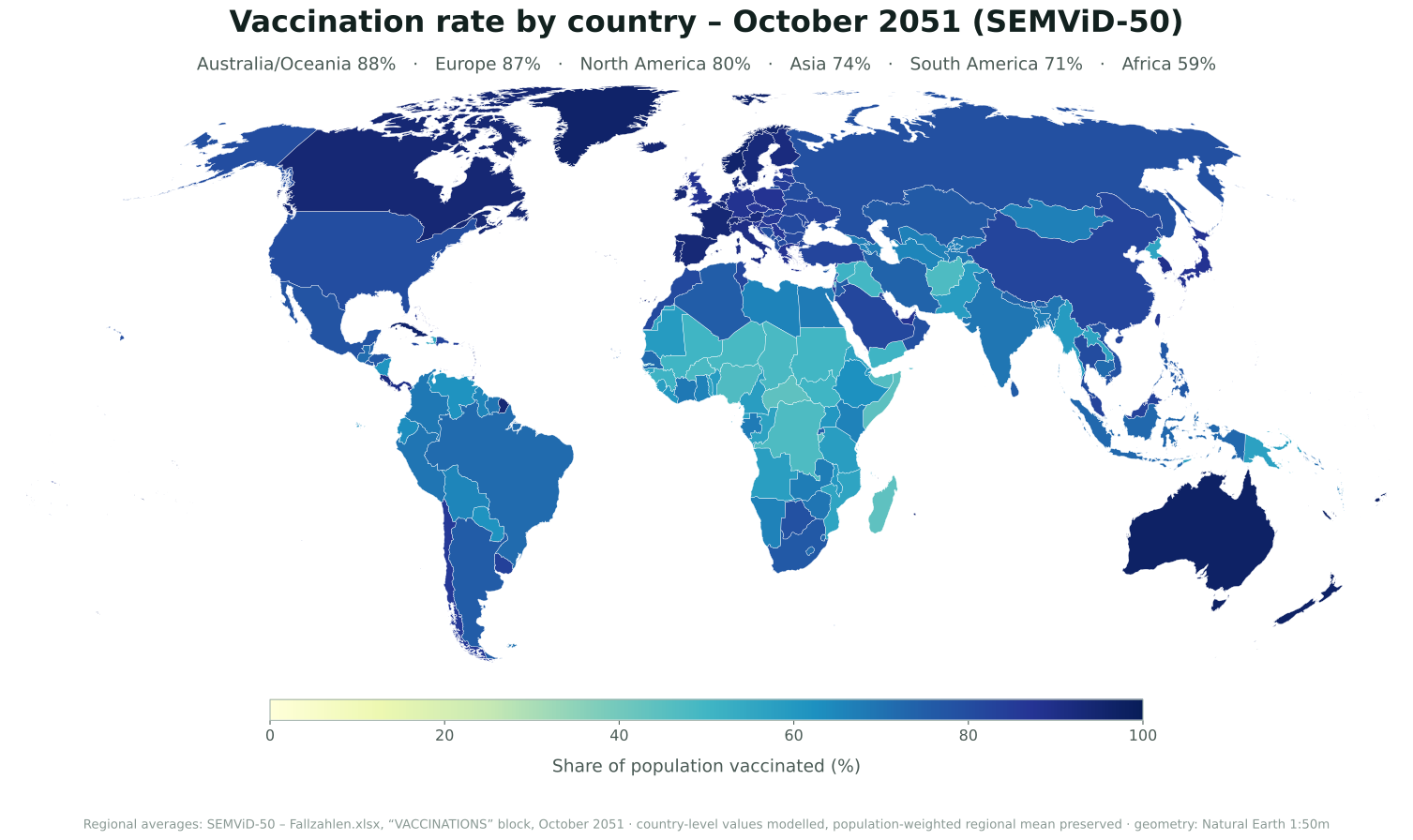
The vaccination campaign was considered a major factor in limiting the further spread of the pandemic. By October 2051, approximately 71% of the global population had completed the primary vaccination schedule. Vaccination coverage was highest in Australia and Europe, at approximately 87–88% of the population, followed by North America at approximately 80% and Asia at approximately 74%. Coverage was lower in South America, at around 71%, and in Africa, where approximately 59% of the population had completed the vaccination schedule. Despite these regional differences, rapid international scientific cooperation and decentralised vaccine manufacturing helped to prevent the severe supply shortages and extreme inequalities in vaccine access that had characterised earlier pandemics.
Mechanism
The SEMVac vaccine is injected into the bloodstream. The active component of the vaccine is a mRNA strand which encodes the BPP3 and NSB5. A combination of mRNA modifications for increased stability and raised translation and specifically immune-activating adjuvancy causes the human body to produce antibodies and memory cells against SEMViD with minimum adverse effects. To take effect, SEMVac needs to be applied two times with four-week distance. It is as of now unknown whether a refresh vaccination is necessary to maintain immunity. Newly discovered molecules provide a heat isolation for the vaccine, allowing it to withstand warm temperature for a intermediate duration of time.
Effectiveness
The two viral proteins BPP3 and NSB5 play a central role in the infection process and can therefore serve as targets for vaccination. BPP3 is located on the surface of the virus and enables the virus to attach to human cells. The vaccine presents the immune system with a harmless version of this protein. As a result, the body produces specific antibodies that recognize BPP3 and prevent the virus from attaching to cells. NSB5 is subsequently responsible for the entry of the virus into the host cell. Antibodies against this protein block the fusion of the viral and cellular membranes that is necessary for viral entry. The vaccine therefore prevents two key steps of the infection simultaneously: attachment to the cell and entry into the cell. This makes infection significantly more difficult or can prevent it altogether. The vaccine has an efficacy of 95% against infection and reduces the viral load in infected individuals by approximately 90%. Protection against symptomatic disease is 97%. The vaccine is particularly effective against severe disease: the risk of severe illness is reduced by 99%, while the risk of death is reduced by 99.5%.
Side Effects of the SEMViD Vaccine
The SEMViD vaccine is generally considered to be well tolerated. The most common side effects are mild and temporary. They include pain, redness or swelling at the injection site, fatigue, headaches, mild fever, and muscle and joint pain. These reactions occur as a result of immune system activation and usually subside within a few days.
The side effects are mainly caused by the intended immune response to the viral proteins BPP3 and NSB5. When the immune system is activated, inflammatory mediators are released, which can temporarily cause symptoms such as fever, fatigue, or headaches. Severe side effects occur only very rarely. These may include severe allergic reactions, for example. The safety of the SEMViD vaccine is therefore continuously monitored even after its approval.
Overall, the side effects are predominantly short-lived and mild, while the vaccine provides a very high level of protection against illness, severe disease, and death.