
About this project
This wiki is the output of a workshop held at the Summer Academy of the German Academic Scholarship Foundation (Studienstiftung des deutschen Volkes) in Leysin, Switzerland, in August 2026. For a week, the students of Working Group 4 (AG 4) traveled to October 2051, where the end of a fictional pandemic, caused by the imaginary SEMViD virus, had just been declared by the World Health Organization. With the aim of exploring the wide variety of scientific and societal aspects of pandemics, the students from various disciplines filled this fictional scenario with details about the properties of the virus and the disease, the events of the outbreak, medical and public health countermeasures, societal impact, and the risks of misinformation. Taking inspiration from Wikipedia (specifically its COVID-19 project), the results of this scenario building process were documented in the form of a wiki.
The participants
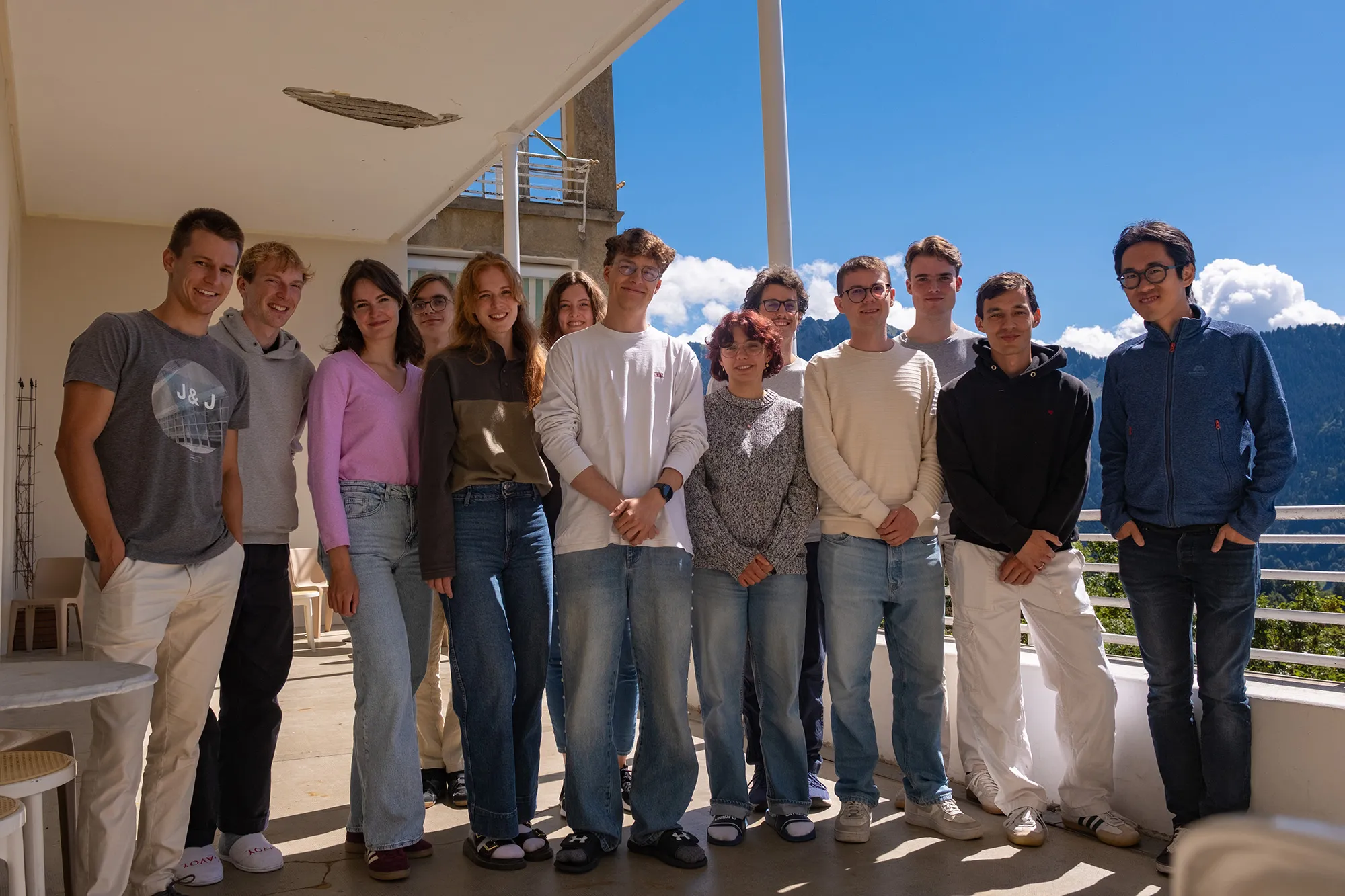
- Cora Burkhard (Medicine)
- Elias Fischer (Biochemistry)
- Hannah Wiesner (Medicine)
- Jakob Reichelt (Visual Communication)
- Jan Birmanns (Mathematics)
- Julia Hartwich (Public Health)
- Leon-Peter Schollmeier (Biology, German Studies, Educational Science)
- Mika Niedernhuber (Business Administration)
- Nicoli Corsac (Medicine)
- Robin Schulze-Tammena (Physics, Mathematics, Computer Science)
- Sebastian Bürger (Physics)
The workshop was led by Dr. Adrian Lison and Dr. Chaoran Chen from the Computational Evolution Group at ETH Zürich. Please feel free to reach out if you would like to know more about the workshop.
The process
The project ran over six half-days at the academy, with some preparation in the weeks before.
- Prior to the academy, everyone received a list of basic material for preparation consisting of podcast and movie recommendations. Further, every participant chose an expert topic and received reading material for preparation.
- During the workshop, the facilitators set the topic and aim of each session while the students decided themselves how to address them. Every day, two students were assigned co-editors and organized the session.
- The structure of the sessions and discussions changed over the week, from a lot of brainstorming in the beginning to a Kanban-style approach towards the end.
- The results were written into a local instance of the DokuWiki software and updated on a rolling basis. This site is a static, read-only export of that wiki.
Preparation material
Basic material (for everyone)
- Four episodes of the German podcast Pandemia: Pest (1) | Hongkong und das Ringen um Ruhm (on the first modern pandemic), Pandemievertrag | Bei SARS-CoV-3 wird alles besser (on the pandemic treaty), Bonus | Tödliches Fieber aus dem Budongo-Wald (on zoonoses and spillover) and Gefährliche Forschung (2) | Synthetische Zellen und die Pandemie aus dem Spiegel (on dual-use research)
- A short self-assessment quiz
- The film Contagion and the two-part discussion of it in the Micro Binfie podcast (part 1, part 2)
Expert topics and material (one per person)
Vaccines
Guiding questions
- How do vaccines work in principle, and what are the main technologies?
- What steps does vaccine development typically go through, up to actual distribution, and what are the biggest challenges?
- Which approaches are being discussed for developing and producing vaccines faster in future?
- What are “platforms” in this context, and what is hoped for from them?
- What keeps people from getting the vaccines they need?
Example material
- Chapter 1: Principles of Vaccination | Pink Book | CDC
- Vaccine Technologies and Platforms for Infectious Diseases: Current Progress, Challenges, and Opportunities
- Vaccine development for emerging infectious diseases | Nature Medicine
- About 1Day Sooner
- What is a Challenge Study? | 1Day Sooner
- CEPI: The 100 Days Mission
- CEPI, topical: CEPI fast-tracks three Bundibugyo ebolavirus vaccine candidates
- A pandemic treaty for equitable global access to medical countermeasures: seven recommendations for sharing intellectual property, know-how and technology | BMJ Global Health
Non-pharmaceutical interventions
Guiding questions
- What kinds of non-pharmaceutical intervention (NPI, sometimes called public health and social measures, PHSM) are there, and how are they meant to act on transmission?
- Which kinds of NPI suit which transmission mechanisms and patterns of spread? How can their effectiveness be studied or estimated?
- What psychological, social and economic consequences do the various measures carry, and how can those be softened?
- Under what conditions does resistance to measures arise, and how does it show itself?
- How have governments decided about putting NPIs in place in the past, and how should they best decide and communicate?
Example material
- Public health and social measures during health emergencies such as the COVID-19 pandemic: An initial framework to conceptualize and classify measures
- The WHO PHSM Knowledge Hub: WHO Public Health and Social Measures Initiative
- A decision framework for effective, equitable and context-specific public health and social measures during public health emergencies: decision navigator (see Fig 8 for an overview)
- Examples of successful early intervention: Epidemics That Didn't Happen | 2024
- Improving the impact of non-pharmaceutical interventions during COVID-19: examining the factors that influence engagement and the impact on individuals | BMC Infectious Diseases
- COVID-19: examining the effectiveness of non-pharmaceutical interventions | Royal Society
Contact tracing methods
Guiding questions
- What are the aims and the challenges of contact tracing?
- How do the pathogen's properties and the way it is transmitted affect how well contact tracing works?
- How do (decentralised) contact tracing apps work?
- Which approaches could make contact tracing faster or better in future, or detect infections earlier?
Example material
- Digital Epidemiology, chapter 7
- Contact tracing
- Bidirectional contact tracing could dramatically improve COVID-19 control | Nature Communications
- Real-time alerting system for COVID-19 and other stress events using wearable data | Nature Medicine
- Detection and Monitoring of Viral Infections via Wearable Devices and Biometric Data
Antivirals and other treatments
Guiding questions
- How do antivirals work in principle, and what are the main kinds?
- How are antivirals developed and tested?
- What other therapies are being researched at the moment?
- What keeps people from getting the medicines they need?
Example material
- The Pandemia episode on Ebola, Die Angst der Anderen
- A review: Mechanism of action of antiviral drugs
- Antiviral drug discovery and development: challenges and future directions
- A pandemic treaty for equitable global access to medical countermeasures: seven recommendations for sharing intellectual property, know-how and technology | BMJ Global Health
- Antiviral strategies for epidemic and pandemic preparedness | Cell Host & Microbe
- Aptamers: precision tools for diagnosing and treating infectious diseases | Frontiers
Surveillance systems
Guiding questions
- What approaches are there for spotting and following outbreaks early?
- Which of them are in place in Germany and Europe, and who is responsible for them?
- What are the strengths and weaknesses of each approach? Which kinds of epidemic is each best suited to?
- How can different approaches complement one another and work together?
Example material
- Infectious Disease Surveillance in the Big Data Era: Towards Faster and Locally Relevant Systems | The Journal of Infectious Diseases
- Towards a genomics-informed, real-time, global pathogen surveillance system | Nature Reviews Genetics
- Wastewater Collection and Sequencing as a Proactive Approach to Utilizing Threat Agnostic Biological Defense
- Pandemics: spend on surveillance, not prediction
- For the surveillance systems used in Germany, search for: IfSG reporting system and DEMIS, SurvNet, TESSy, SUMO, GrippeWeb, IGS, AMELAG
Laboratory safety and high-containment labs
Guiding questions
- How do high-containment laboratories work, what are they used for, and by whom?
- What criticism is there of the spread of such laboratories and of the research done in them? What has to be weighed against what?
- What are the most important safety measures in a high-containment laboratory, and what are the commonest kinds of accident?
- Which future developments, technological or regulatory, could improve safety, and which could threaten it?
Example material
- Growing number of high-security pathogen labs around world raises concerns | Science
- The rise of maximum containment laboratories (video)
- Global Biolabs | Bulletin of the Atomic Scientists
- CDC LC Quick Learn: Recognize the four Biosafety Levels
- Laboratory accidents and biocontainment breaches: Policy options for improved safety and security
- Risk-based reboot for global lab biosafety | Science
- Cyberbiosecurity Implications for the Laboratory of the Future | Frontiers
- COVID-19 lab leak theory
Genome synthesis and editing
Guiding questions
- Where does the technology for synthesising and editing genes stand: what is already feasible, and what will probably become possible?
- What are genome synthesis and editing used for in research on communicable disease?
- How could genome synthesis and editing be misused to make biological weapons, and how can that be prevented?
Example material
- Synthetic Generation of Influenza Vaccine Viruses for Rapid Response to Pandemics | Science Translational Medicine
- Pandemic preparedness: synthetic biology and publicly funded biofoundries can rapidly accelerate response time | Nature Communications
- Gain-of-function experiments: time for a real debate | Nature Reviews Microbiology
- Strategies for the Risk Analysis of Genome Editing | BTWC
- Assembling unregulated DNA segments bypasses synthesis screening: regulate fragments as select agents | Nature Communications
- Strengthening nucleic acid biosecurity screening against generative protein design tools | Science
Genetic forensics
Guiding questions
- What could forensic methods be used for around an outbreak? What could they establish?
- What approaches are there for working out where a pathogen came from?
- What makes that difficult, and how do developments in biological AI bear on it?
- What political questions arise when genetic forensics is used? Who should carry out such investigations, and how should they communicate about them?
Example material
- The biosecurity benefits of genetic engineering attribution | Nature Communications
- A machine learning toolkit for genetic engineering attribution to facilitate biosecurity | Nature Communications
- The Genomic Epidemiology Handbook, chapters 2 and 3
- Origin of SARS-CoV-2
- Analysis of the first genetic engineering attribution challenge | Nature Communications
Genomic data and data sharing
Guiding questions
- How is a genetic sequence determined from a biological sample?
- Who produces that data? Who are the stakeholders?
- How and where is genomic data shared at the moment?
- What is the Pathogen Access and Benefit Sharing (PABS) framework, currently under negotiation as part of the pandemic treaty, about?
Example material
- What is genomic sequencing? | CDC
- Whole genome sequencing
- Pandemic talks consider two opposing models for pathogen sharing | Health Policy Watch
- Landscape of non-SARS-CoV-2 respiratory virus sequence data in Africa
- Attributes and principles of genomic data-sharing platforms supporting surveillance of pathogens with epidemic and pandemic potential
- Control issues: invented persona behind key pandemic database | Science
Climate change and other global drivers of pandemics
Guiding questions
- Which global developments make pandemics more likely, and how exactly do they act?
- Which factors make a novel outbreak in Europe specifically more likely?
- Which of those factors can be influenced in the short term, say by policy, which only in the long term, and which not at all?
Example material
Infodemics and misinformation
Guiding questions
- How does misinformation affect public health and pandemics, and how did it?
- Which forms of misinformation are typical of a pandemic?
- What approaches are there for countering it?